Energy & Healing
What Is Reiki, Really? A Grounded Introduction
The word Reiki can mean very different things depending on who you ask. Rather than beginning with what you should believe, let's begin with a simpler question: what is Reiki, really?
By Kiranmaye Cartier7 min read
The word Reiki can mean very different things depending on who you ask.
For some, it is a deeply spiritual practice. For others, it is simply an opportunity to become still, receive gentle attention and step away from the constant activity of everyday life. And for someone encountering Reiki for the first time, the language surrounding it — energy, chakras, healing, universal life force — can understandably raise more questions than answers.
At TheAtmaStory, we don't believe you need to accept every spiritual idea before you can explore one. So rather than beginning with what you should believe about Reiki, let's begin with a simpler question:
What is Reiki, really?
Reiki begins with the idea of energy
Reiki is a Japanese spiritual healing practice that developed in the early twentieth century and is most closely associated with Mikao Usui. The word is commonly explained through two Japanese concepts:
Rei — often interpreted as universal or spiritual. Ki — life energy or vital energy. This idea of a life force is not unique to Reiki. Different cultures and philosophical traditions have developed their own ways of understanding subtle or vital energy — qi in Chinese traditions and prana within Indian traditions are familiar examples.
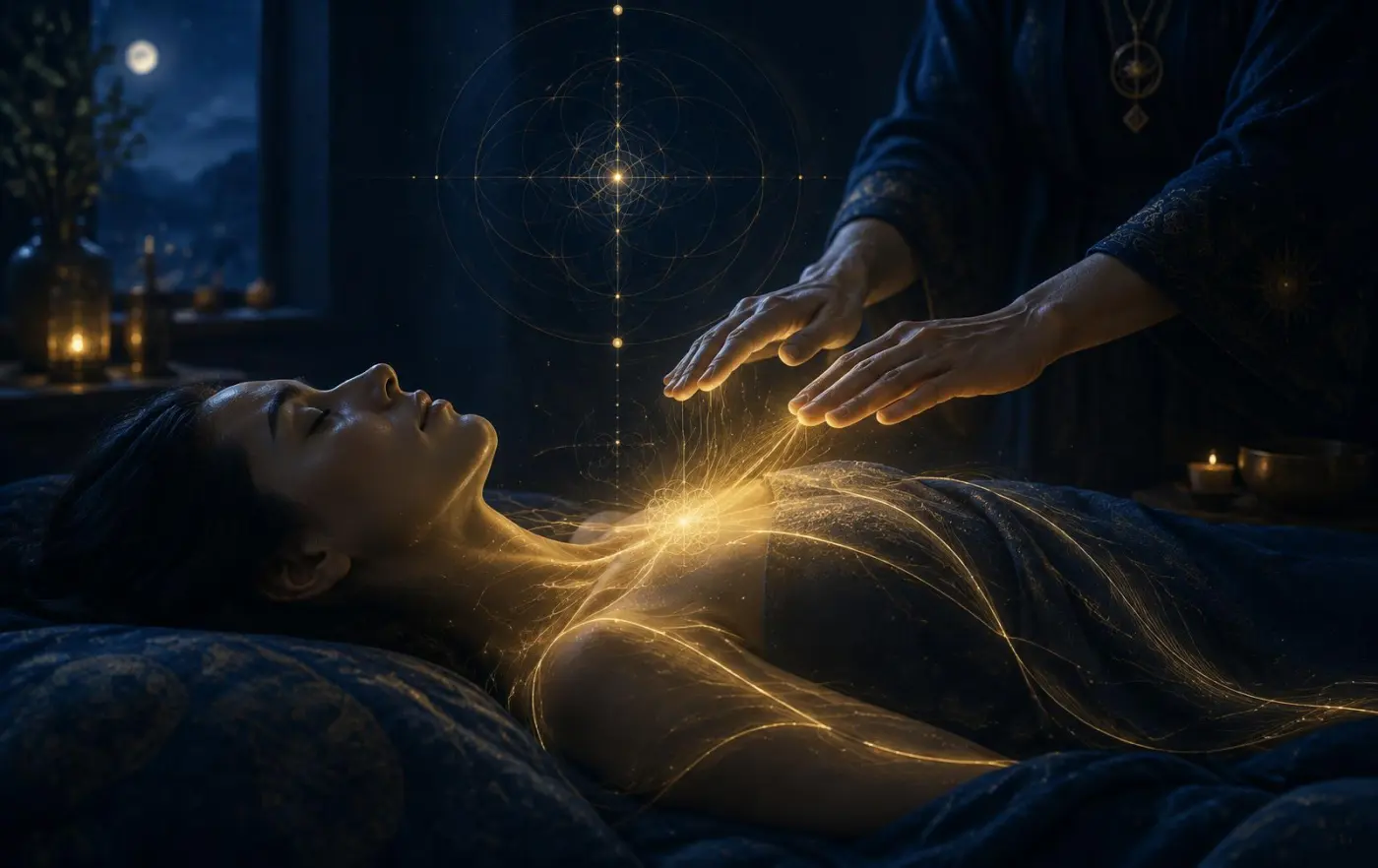
These concepts are not interchangeable, and they come from different traditions. But they reflect a recurring human idea: that our experience of being alive may involve more than the physical structures of the body alone. Reiki works within that spiritual understanding. A practitioner uses gentle touch, or holds their hands slightly above the body, with the intention of facilitating Reiki energy. Reiki can also be practised without physical contact and, within Reiki traditions, at a distance.
You remain fully clothed. There is no manipulation of the body. A session is generally quiet, still and gentle. And importantly, you don't have to manufacture an experience. You simply receive.
So what is the practitioner actually doing?
This is where Reiki can become unnecessarily complicated. A Reiki practitioner is not supposed to be giving you their own personal energy. Within Reiki philosophy, the practitioner acts more like a channel or facilitator. That distinction is important to how I understand spiritual work more broadly.
I don't see myself as the source of healing. I see myself as an instrument. During Reiki, the practitioner's role is to create a focused space, connect with the practice they have been trained in and allow the session to unfold without forcing a particular result. Some people describe sensations such as warmth, tingling, heaviness, lightness or deep relaxation. Others become emotional. Some see colours or images. Some fall asleep.
And some feel very little at all.
There is no correct Reiki experience.
A dramatic sensation isn't evidence that you had a “better” session, and feeling nothing unusual doesn't mean that you did Reiki incorrectly.
Is Reiki scientifically proven?
This is where I think a grounded spiritual practice needs to be comfortable with an honest answer. There is research into Reiki, including studies looking at outcomes such as anxiety, pain, stress and quality of life. Some studies and reviews have reported promising results. However, the scientific evidence is not strong enough to establish the traditional concept of Reiki energy as a scientifically demonstrated mechanism, and limitations in study quality make it difficult to draw firm conclusions about clinical effectiveness.
That distinction matters. Someone can have a meaningful personal experience of Reiki without that experience becoming scientific proof of a universal energy system. Likewise, uncertainty within science does not require us to dismiss someone's subjective spiritual experience. Those two ideas can coexist.
I came to spirituality with a mind that naturally asks:
Why?
How?
What is actually happening?
My background taught me to value logic, evidence and analysis. Spirituality did not make me want to switch that part of myself off. If anything, it gave me another set of questions. Reiki sits in that space for me: something that can be experienced spiritually without pretending that every spiritual explanation has been scientifically established.
Reiki is not a replacement for medicine
This deserves to be completely unambiguous. Reiki should not replace appropriate medical treatment, mental-health support, medication, diagnosis or emergency care. If you are unwell, Reiki is not a reason to delay seeing a qualified healthcare professional. I prefer to think about Reiki as a complementary spiritual and wellbeing practice.
Someone might receive conventional medical care and also practise meditation. Someone might see a therapist and also pray. Someone might exercise, journal, spend time in nature and receive Reiki. Human beings often draw support from different dimensions of life.
They don't necessarily have to compete.
What does “healing” mean, then?
This may be the most important distinction of all. In everyday language, we often hear healing and assume it means curing a disease. That is not how I use the word in Reiki. Healing can mean creating space for rest.
It can mean recognising something you've been carrying. It can mean feeling emotionally lighter. It can mean reconnecting with yourself after months of moving through life automatically. It can mean becoming aware of a pattern.
Sometimes healing isn't about becoming a completely different person. Sometimes it begins with simply experiencing yourself differently. That is a much more grounded way of understanding what a spiritual healing practice can offer.
Where do chakras and the aura fit in?
This is another area where different spiritual traditions often become blended together. Reiki originated in Japan. The chakra system, meanwhile, has roots in Indian spiritual and yogic traditions. Modern energy-healing practices frequently bring these frameworks together, but it is useful to understand that they did not originally emerge as one single system.
At TheAtmaStory, our wider spiritual work can explore energetic frameworks including the chakras, koshas and aura. I regard these as spiritual frameworks through which people can explore different layers of their experience — rather than presenting them as anatomical structures that conventional medicine can measure. That distinction allows us to explore them deeply without pretending spirituality and medical science are saying exactly the same thing.
Do you have to believe in Reiki for it to “work”?
I don't think someone needs to arrive with absolute belief. In fact, I am comfortable with questions. You can be curious. You can be sceptical.
You can believe strongly in energy. You can be unsure what you believe. What matters more is that you come voluntarily and openly enough to experience the session for yourself. Spirituality should not require you to surrender your critical thinking.
There is a difference between being open-minded and being unquestioning. The first allows exploration. The second can make us vulnerable to accepting almost anything. I prefer the first.
Reiki and the soul's story
This is where Reiki connects with the wider philosophy behind TheAtmaStory. I don't see a person simply as a collection of problems requiring correction. Every person arrives with a story.
Experiences.
Relationships.
Pain.
Joy.
Patterns.
Questions.
Beliefs.
Memories.
And, depending on your spiritual worldview, perhaps dimensions of that story extending beyond what we immediately understand. Reiki doesn't need to provide an explanation for every chapter. Sometimes its role is much simpler. To create stillness.
To allow attention to turn inward. To give the person permission to stop doing and simply be. And from that quieter place, perhaps something can be sensed differently.
A meeting place between two perspectives
I did not come to Reiki because I wanted to abandon logic for spirituality. My journey has been almost the opposite. I wanted to understand both. There are questions science is extraordinarily good at answering.
There are questions spirituality has attempted to explore for thousands of years. And there are questions for which we may simply have to admit:
We don't know yet.
I find something freeing in that. Reiki does not have to prove the entire nature of consciousness for someone to value an hour of stillness, reflection and spiritual connection. Nor does someone's profound experience during Reiki prove every metaphysical explanation ever attached to energy healing. There is room between those extremes.
That is where I prefer to practise.
With curiosity.
With respect for tradition.
With openness to spiritual experience.
And with enough grounding to know the difference between what we believe, what we experience and what we can prove. Perhaps that is a useful way to approach Reiki for the first time. You don't have to decide what Reiki is before experiencing it. You can simply arrive with curiosity and ask:
What does this experience mean to me?
Because ultimately, Reiki is not about adopting somebody else's story. It is another opportunity to listen more closely to your own. ----------------------------------------------------
Every soul has a story.
SenseBalanceHealTransformTranscend
Kiranmaye Cartier
Soul Reader & Psychic Medium · Founder of TheAtmaStory
A science student and corporate professional of almost 25 years who came to explore the soul's perspective — and brought her logical mind with her. She continues to question, observe, experience and make sense of both perspectives.
About Kiranmaye →Continue exploring
Kiranmaye Cartier
Soul Reader & Psychic Medium · Founder of TheAtmaStory
A science student and corporate professional of almost 25 years who came to explore the soul's perspective — and brought her logical mind with her. She continues to question, observe, experience and make sense of both perspectives.
About Kiranmaye →